

Recognising God
Some wisdom from Elanor

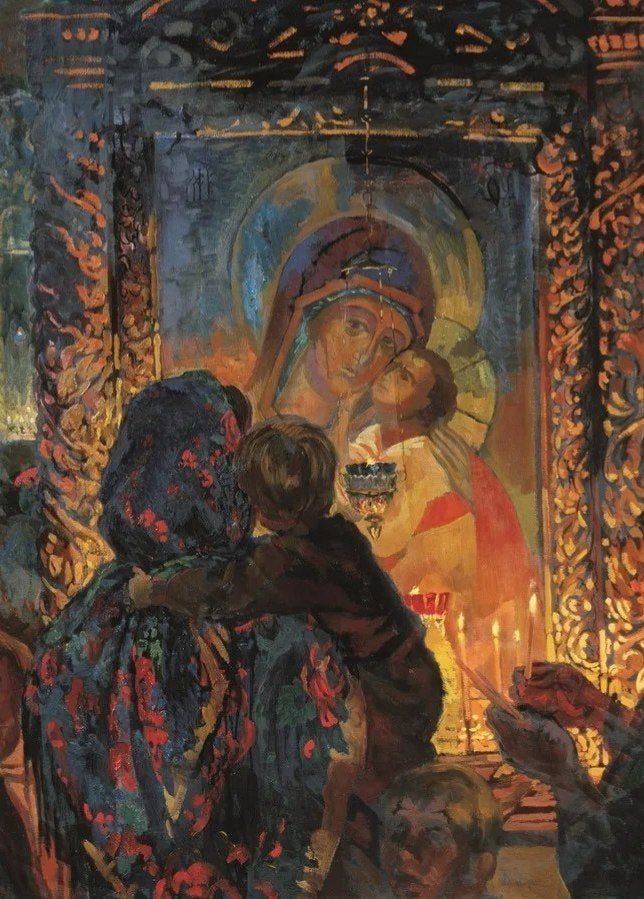
Every time she sees a Madonna and child,
my youngest girl, Elanor, exclaims ‘look Mama, it’s me and you’. It doesn’t matter how varied the figures: they can be eastern icons, German carvings, or renaissance paintings. In the form of the Christ child tenderly held, she sees herself. To her, every loving mother looks like me, every beloved child looks like her, and I am always a little astonished and unravelled to discover this again.
But there is also challenge for me, because in Elanor’s startling assertion, I begin to ‘see’ myself in the Madonna of the picture in a way that tests my assumptions about love and asks me to love much more fiercely than I have yet known how.
Children do this, of course. I did not know my capacity for self-gift before it was demanded of me by my babes.
But their demand has moved beyond the love they ask for themselves and required me to widen my remit. The more I cradle my own little girl and her siblings, the more I navigate her foibles and needs and fears, the more I ‘recognise’ her in the forms of the children I meet out in the world. Every child in some sense, begins, strangely, to look like my own.
Every person.
This has astonished me of late. I have never felt that mercy was my spiritual gift. If I am to be perfectly honest, I must admit that there have been numerous times in my life when I have looked upon great crowds of people and wondered how in the world God can love us all. Not only are we so mind-bogglingly many, we humans are so inane. So mediocre. So nondescript. The divine is so obscured in us so much of the time.
But since my babes were placed in my arms, a healing of that faulty sight has begun in me. If there’s one thing I believe a parent is asked to do, it’s to study their child. We don’t get to say what temperament or needs or hungers our children are born with. We don’t get to dictate the shape of their personhood. They are, as the fruits of love always are, gift. My thanks as a mother is to study that gift, to receive this new person with real hospitality, welcoming not the child I imagined, but the child here, before me, burning with the image of God in their own particular way.
That means I’ve become rather adept at searching for the divine in the faces of often grubby, ever-earthy little beings.
And as I do, I find that there is a real sense in which my children have required me to remember that the different people who cross my path all began as small children. Each one, still inside, a little one as fragile and love-hungry as my own. Each one a gift to be received, studied, tended so that the image of God may shine out plain within the holy particularity of their ordinary faces with their unrepeatable aspect.
There’s a kind of vision, then, that comes to me at times that is a distillation of attention, a new summons to love. Have you ever experienced this? As a child, I wonder if it was God’s attention I felt: I knew it as an abrupt, disquieting awareness of myself, my body. I’d look at my hands as if seeing them for the first time, feel the thump and rush of my blood as if it was something only just set in motion. The experience was so disturbing and strange and, yes, grand (because what else can it be to really discover that you are alive, alive!, and loved) that I could never sustain it for long.
But it comes to me sometimes now when I look at my children. I will hold one of them, grumpy, difficult at bedtime, just as they begin to nod off, all sweaty and annoyed. And suddenly the whole of my consciousness will arrive out of its scattered wandering into that moment. Summoned there, to behold the particular curve of my child’s neck, their damp hair, the pulse in their throat. The preciousness, the unutterable preciousness of their existence in my arms.
Very, very occasionally now, that sight comes to me for someone who is not my child. For someone a little troubled or angry, difficult or just flummoxed by life. Time slows, attention hones, and there. I can see them, the astonishing fact of their existence, their worth, their grief. And for a moment, I can hold them in my heart as I hold my children, and pray for their flourishing.
I can give a similar exclamation as Elanor, if slightly reversed: ‘look Lord, it’s you!’ In that troubled face, that generous heart, that joyous spirit. I recognise You. And know that the vision granted is that of Love. Imagine if we all went abroad in the world, searching hard for the loveliness in each face we beheld, however troubled, exclaiming at each other’s beauty, at the wondrous way we each in our turn bear the likeness of our beautiful God…
I hold my daughter close and dream.
Beautiful. I had the gift of this very experience in my years teaching sixth graders. God gave me the mind and heart to see each of them as my "favorite"-- which is, of course, how God sees each of us. I told each of them over and over, "You're my favorite.". And, by his grace, they each came to be convinced. Years later, they still ask me, "Am I still your favorite?"
I often reflect on this observation by Charlotte Mason in her book School Education (pg 33)
Serenity of a Madonna.––It is not for nothing that the old painters, however diverse their ideas in other matters, all fixed upon one quality as proper to the pattern Mother. The Madonna, no matter out of whose canvas she looks at you, is always serene. This is a great truth, and we should do well to hang our walls with the Madonnas of all the early Masters if the lesson, taught through the eye, would reach with calming influence to the heart. Is this a hard saying for mothers in these anxious and troubled days? It may be hard, but it is not unsympathetic. If mothers could learn to do for themselves what they do for their children when these are overdone, we should have happier households. Let the mother go out to play! If she would only have courage to let everything go when life becomes too tense, and just take a day, or half a day, out in the fields, or with a favourite book, or in a picture gallery looking long and well at just two or three pictures, or in bed, without the children, life would go on far more happily for both children and parents. The mother would be able to hold herself in 'wise passiveness,' and would not fret her children by continual interference, even of hand or eye––she would let them be.